Trailing Stops for Trend Following: How Far to Trail
How trailing stops work in trend-following bots: ATR vs percentage vs indicator trails, choosing the right distance, and the pitfalls that cut winners short.
What a trailing stop actually does
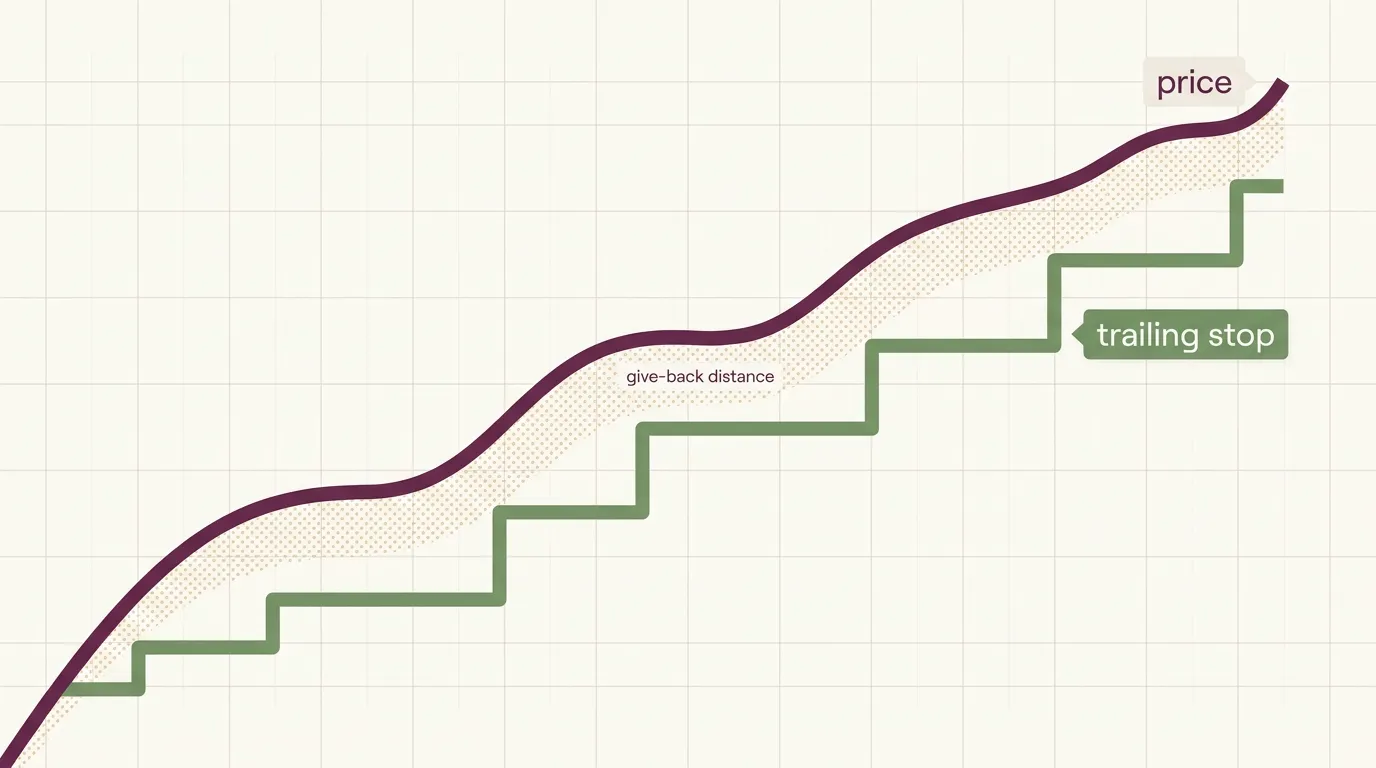
A trailing stop is an exit that only moves in the direction of your trade. In a long position it ratchets up as price makes new highs and never moves down; in a short it ratchets down. The trade ends when price retraces far enough to touch it.
That single rule is what makes trend following work. You cannot know where a trend ends, so you stop trying to predict it and instead define how much give-back you'll accept. Everything else — entry, filter, market — matters less than getting this distance right.
A trailing stop doesn't pick the top. It buys you the right to stay wrong about where the top is.
The three ways bots trail
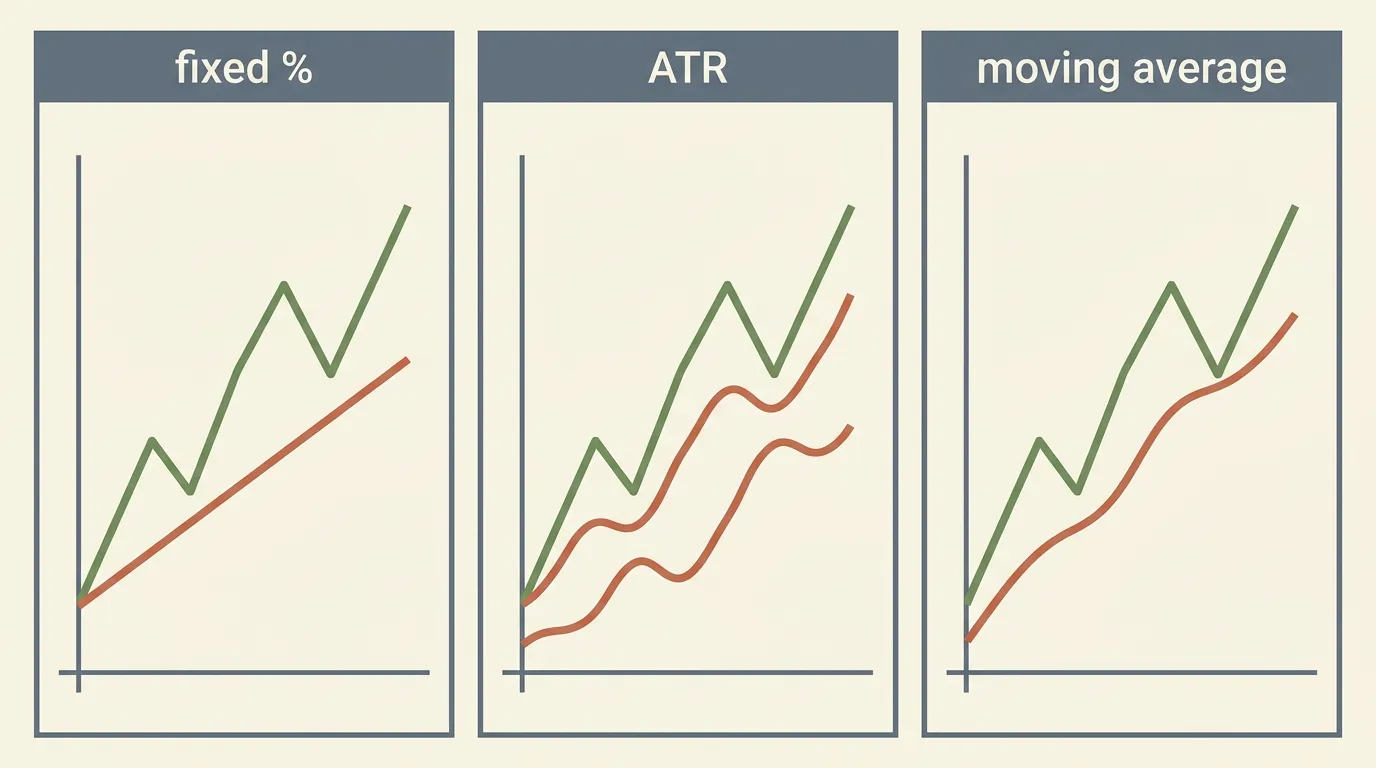
Most trailing exits fall into one of three families. They behave very differently in live markets.
A fixed percentage is simple but blind: 3% is enormous in a quiet forex pair and trivial in a small-cap. An adapts automatically — when the market calms down, the stop tightens; when it expands, the stop gives more room. Indicator trails, like exiting on a close below a 20-period EMA, are the loosest of the three and tend to give back the most, but they hold the biggest winners.
Choosing the distance: the core trade-off
There is no optimal trailing distance — only a trade-off you choose deliberately.
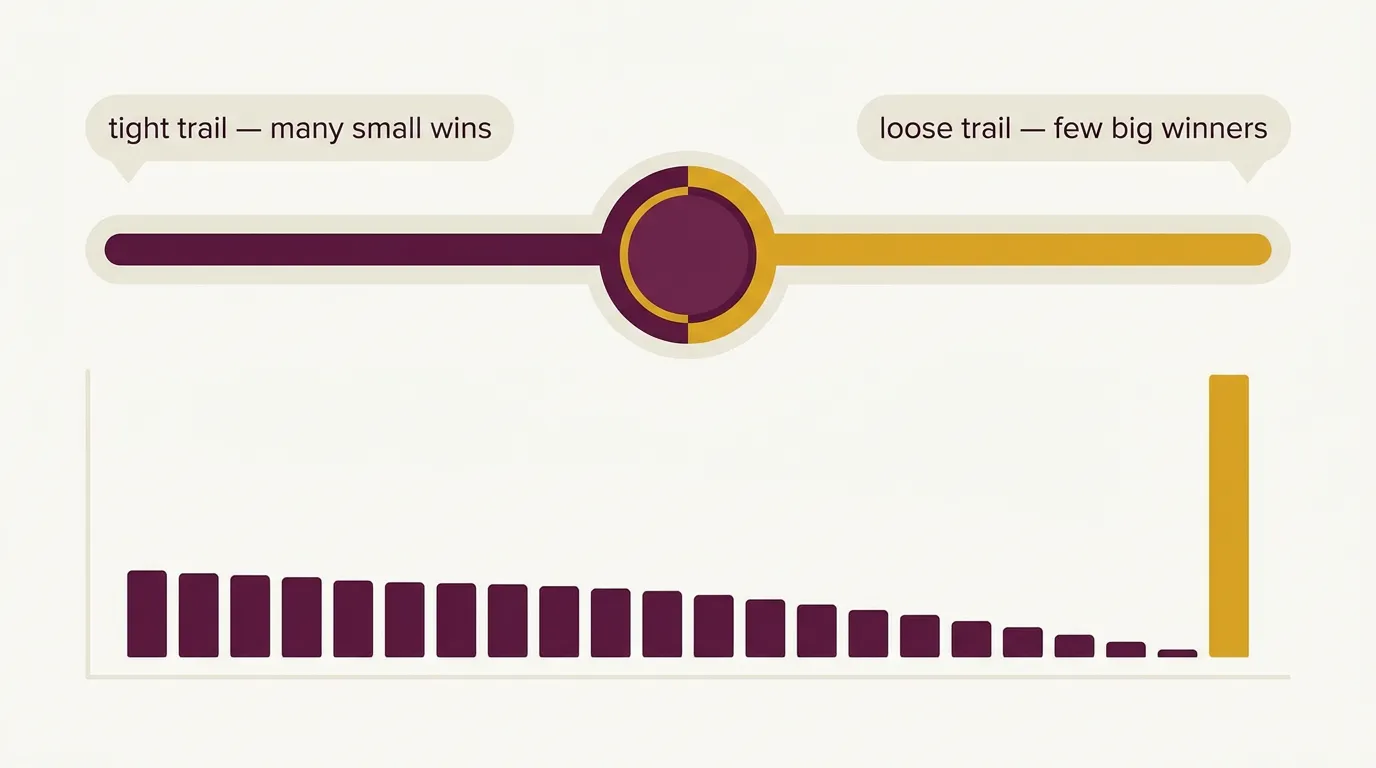
- Tight trails (1–1.5× ATR): higher win rate, many small profits, frequent stop-outs during normal pullbacks. You will exit strong trends early and repeatedly.
- Loose trails (3–4× ATR): lower win rate, but the occasional trade runs for weeks. Expect to hand back a painful chunk of open profit on every trade that ends.
Trend following is a low-hit-rate business. A handful of large winners pays for a long tail of small losses, which means a trail that's too tight quietly destroys the edge — it cuts off exactly the outliers the strategy depends on. If you're uncomfortable giving back open profit, the honest fix isn't a tighter stop; it's a smaller position, sized with , plus on part of the position while the rest keeps trailing.
Trail off closed candles, not intraday wicks. Wick-based trails get picked off by single spikes and turn a 3× ATR stop into an effectively much tighter one.
Practical rules that save trades
A few implementation details matter more than the exact multiple you pick.
- Start with a fixed initial stop. Don't trail from bar one. Use a normal stop until the trade is meaningfully in profit, then switch to trailing. Trailing immediately on a fresh entry usually just tightens your stop before the move begins.
- Match the trail to the timeframe. A 4-hour trend with a 15-minute trail is not a trend strategy — it's noise harvesting with extra fees.
- Never widen a trail mid-trade. A stop that moves away from price is not a stop.
- Account for costs. Frequent trailing exits mean frequent re-entries, and compound fast on choppy instruments.
- Test the multiple out of sample. Trailing distance is the easiest parameter in the world to overfit — a 2.7× ATR that "wins" on one history is usually curve-fit noise.
On algomax you don't build any of this by hand: you describe the exit in plain language — "trail the stop at two and a half times ATR from the highest close, once the trade is one ATR in profit" — and the AI assistant turns that conversation into a ready-to-run bot you can backtest on historical candles before going live through your own broker keys.
Key takeaways
- Trailing stops define your acceptable give-back, not a price target — that's what lets trends run.
- ATR-based trails adapt to volatility; fixed percentages don't, and indicator trails are the loosest.
- Tighter trails raise win rate but cut off the outlier winners that fund trend following.
- Trail on closed candles, start trailing only after the trade is in profit, and validate the distance out of sample.
Frequently asked questions
What is a good trailing stop distance for a trend-following bot?
There is no universally good distance — most trend systems use roughly 2 to 4 times ATR, with tighter trails raising the win rate and looser trails capturing bigger moves. The right choice depends on your timeframe and how much open profit give-back you can tolerate, and it should be validated on out-of-sample data.
Should a trailing stop be based on percentage or ATR?
ATR-based trails adapt automatically as volatility expands and contracts, which usually makes them more robust across regimes. Fixed percentages are simpler and can work on crypto where volatility scales with price, but they behave inconsistently across different instruments.
Why does my trailing stop keep exiting before the real move?
Usually the trail is too tight for the timeframe, or it is reacting to intraday wicks instead of closed candles. Starting with a fixed initial stop and only switching to trailing once the trade is meaningfully in profit also helps avoid premature exits.
Can I combine a trailing stop with taking partial profits?
Yes, and it is a common compromise. You close part of the position at a fixed target to bank something concrete, then let the remainder trail so a strong trend still contributes a large winner.
Can I set this up on algomax without coding?
Yes. You describe the trailing rule conversationally — for example, trail at a multiple of ATR from the highest close — and the AI assistant turns it into a ready-to-run bot you can backtest and then deploy through your own broker keys.